Home / Drawing register / Sheet 04
Sheet 04 · Roofs
Old slate roof: repair it or strip and re-slate?
Slate can outlast the nails holding it by a very long way. Working out which of the two has failed tells you most of what you need to know about the bill.
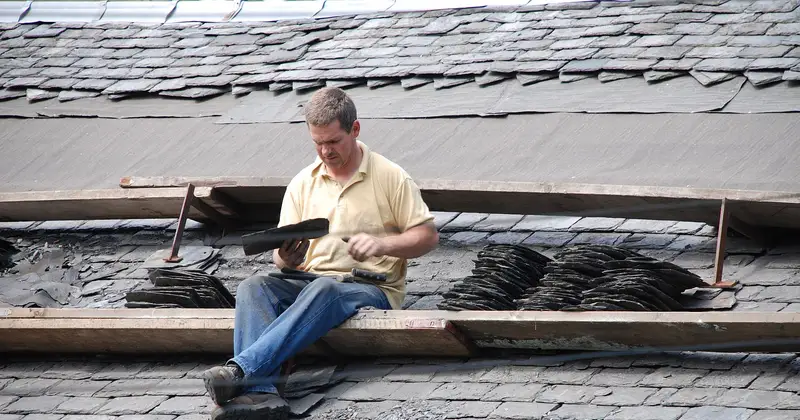

Repair while the failure is local. Re-slate when fixings are going across a whole slope and repeat repairs have stopped making sense. SPAB's technical note on south-west slating puts the reason neatly: the slate is durable and may last hundreds of years, but a roof's life is set by its fixings, because pegs and laths rot and nails rust. It adds that the decision to re-slate is often triggered by the repeated cost of scaffolding for repairs.
A slate on the path therefore tells you little by itself. One or two slips after a storm are maintenance. Slates sliding from all over the slope, year after year, suggest the fixings are coming to the end of their working life.
What to look at, from the ground and the loft
SPAB's roof maintenance advice is to check the roof twice a year. Binoculars from the pavement are safer than a ladder and will show most of what you need. Look for slipped, broken or missing slates, loose ridge and hip pieces, and split or lifting lead at chimneys and abutments. Cracked mortar fillets deserve attention because junctions are the usual trouble spots.
Then go into the loft on a bright day and again after rain. Look for water staining on rafters and laths, bearing in mind that the mark may be some distance from the point of entry. Underlay only became usual from the mid-20th century, so seeing the underside of the slates is not itself a fault. Wet timber is another thing. Check too that loft insulation has not been pushed down to the eaves, where it blocks ventilation and promotes damp and decay. If damp is showing on bedroom walls below, work through our damp checklist as well.
Repairs that make sense
Most small repairs on a slate roof are simple in principle:
- Slipped slates. True slates can be refixed with copper wire or strip, known as tingles. Heavier stone slates have to be nailed or pegged instead.
- Ridges and hips. Rebed loose pieces in lime mortar.
- Fillets. Repoint cracks, or re-form them if the cracking is extensive, in soft lime mortar rather than cement. SPAB prefers keeping a traditional fillet over swapping it for lead.
- Lead flashings. Replace a damaged length in matching material. Vertical splits can be covered with a small new section wedged and pointed above the old.
- Moss. Brush down seasonally if it is excessive. Moisture retention can damage coverings and acidic run-off can corrode some metals.
Repairs to turn down
Be wary of anyone offering to coat or foam the roof. SPAB's advice on bitumen-coated fabric outside and spray-on foam underneath is plain: a false economy that in some reported cases has caused serious damage to the structure. These treatments prevent inspection, make the slates hard or impossible to reuse, and reduce ventilation, raising the risk of timber decay. Grouting or slurrying with mortar falls into the same category, and the south-west note says it can eventually cost far more than re-slating would have. Treat a doorstep offer of this kind with particular suspicion.
SPAB also warns about underlay used to cover for poor workmanship: the slates must still shed water properly on their own.
If it does need re-slating
Ask for a survey of the existing roof before stripping, then a written statement of how it will be done. The south-west note says repairs and re-slating should retain as much historic fabric as possible, and sound slates should be reused or dressed down to remove damaged parts. The number that can be reused will not be fully known until the slope is opened up, so expect a provisional sum. New slate should match the local source wherever one exists, since slate from elsewhere looks different and regional styles vary a great deal. SPAB's technical notes cover several regions. Roof timbers, once exposed, can be checked and repaired at the same time, so allow for it.
Permission: three separate questions
Insulation deserves a slow decision on an old roof. The south-west note warns that care is needed where insulation goes in, and SPAB's damp note says manufacturers' instructions for vapour-permeable underlays must be followed closely to avoid condensation in the roof. Ask how moisture will leave the roof space before you agree to a specification.
Sources
Opened and read by the editors in November 2026. Rules and guidance change, so check the current version.