Home / Drawing register / Sheet 01
Sheet 01 · Damp
Rising damp or condensation? How to tell in a period house
Most damp in an old house gets called rising damp, and a good deal of it is something else. The difference decides whether you need a clean gutter or a much larger bill.
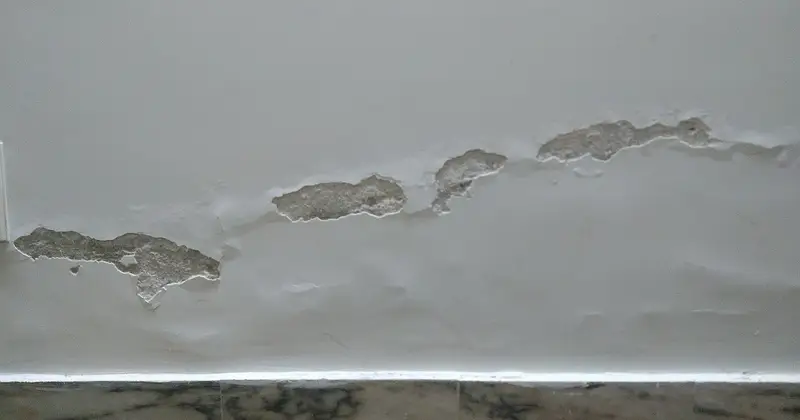

The short answer: look at where the damp is and when it appears. A band low on a wall with a salty tidemark, which stays much the same all year, may be rising damp. Mould in cold corners and behind wardrobes through the winter is condensation. A defined patch that comes back after heavy rain is water getting in from outside. In most period houses it pays to rule out the last two before you consider the first.
That order runs against the sales pitch you may have heard. The Society for the Protection of Ancient Buildings (SPAB) says true rising damp is rarer than commonly perceived but is regularly misdiagnosed. Government guidance on damp and mould, written with rented housing in mind, describes condensation as the most common form of damp in homes generally.
Why old walls behave differently
Damp-proof courses have been required in walls since 1875, according to SPAB, and membranes in floors only from the 1960s. Most old buildings lack these, so some moisture does rise. It usually does no harm while the wall can release it again. Trouble tends to start when that balance is upset, often by something added later: cement render, hard pointing, impermeable paint or a concrete floor.
So a slightly damp base to an old wall is not automatically a defect. The useful question is whether the moisture is more than the wall can lose, and why.
Reading the symptoms
These patterns come from SPAB's technical note on the control of dampness. They are clues rather than a verdict, and more than one cause can be at work in the same room.
| What you see | When | Likely source |
|---|---|---|
| Well-defined patch, stains on ceilings or chimney breasts, green algae or dark patches outside | Reappears after heavy rain, can dry in days | Rain penetration |
| Low band with a sharp edge or tidemark, white feathery salts, rotten skirting | More constant through the year | Ground moisture, possibly rising damp |
| Mould and wet surfaces in cold corners, behind wardrobes, in kitchens and bathrooms | Worse in cold weather and when the room is shut up | Condensation |
| Local dampness, sometimes with a higher water bill or the sound of a leak | Constant or getting worse | Plumbing leak |
| Damp feel on humid days in old plaster with no other sign | Comes and goes with the weather | Hygroscopic salts left by an earlier problem |
Check in this order
1. Go outside in the rain
It costs nothing and it is the check most often skipped. Gutters that cope with an ordinary shower can overflow in a long downpour. SPAB suggests watching the rainwater system during heavy rain, because leaves and moss build up quickly and a choked downpipe can back up and spray out of its joints onto the wall. Cracks on the wall side of a hopper or downpipe are easy to miss from the ground. Look at the roof as well: water can track down rafters and appear some distance from the leak, which is one reason a small slate fault can show up on a bedroom ceiling.
2. Look at ground levels and pointing
Soil, paving or a raised patio against a wall gives water a route around whatever protection the house has. SPAB's note describes outside works, from clearing plants at the foot of the wall to lowering levels to at least 150mm below the internal floor. It also warns that digging near old foundations has structural consequences, so take advice before any excavation. Check the pointing too. Hard cement mortars can let water through hairline cracks, whereas lime tends to absorb moisture and release it later.
3. Think about how the room is used
Condensation depends on air humidity and surface temperature. Cold north-facing walls, cupboards on outside walls and blocked-up fireplaces are all likely spots, and so are rooms where drying laundry or steam has nowhere to go. SPAB says relative humidity is often best kept between 40 and 60%, and that condensation is eliminated by keeping it to a maximum of 70%. A cheap hygrometer will show you what your room is doing over a week. Lids on pans, closed kitchen and bathroom doors, drying clothes outdoors and a gap behind furniture all help, as does opening a window. The same note advises against draught-proofing windows in kitchens and bathrooms, which is worth remembering if you are overhauling your sashes.
4. Only then consider the ground
SPAB's note says rising dampness may extend only 10 to 50mm above floor level, though it can reach 900mm or higher depending on the masonry, the ground and how fast the wall can dry. Expect a fairly sharp change from wet to dry, or a tidemark, sometimes with white salts, peeling paint and rotten skirting. Measures that help the wall to dry, such as replacing hard render or pointing with a lime mortar, may do more than anything injected into it.
The trouble with moisture meters
If a report rests entirely on electrical meter readings, read it sceptically. These meters respond to salts, foil-backed wallpaper, some timber preservatives and carbon-containing materials as well as water, so they can give high readings in a wall that is close to dry. SPAB is direct about this: rising damp is widely misdiagnosed on meter readings alone, and if it is present there will be visible signs too. Meters are still useful for plotting where moisture is and whether it changes over time.
Tests of moisture within the thickness of the wall can help rule out surface condensation. That is specialist work, and it gives a far better basis for spending money.
What about a retrofit damp-proof course?
SPAB's position is a presumption against them in pre-1919 buildings, where they can be damaging, ineffective and an unnecessary expense when installed inappropriately. There are exceptions, such as a building that has been so altered it now works as a sealed modern structure. Physical and chemical courses should be avoided in earth buildings, where major structural damage can result, and treatment is difficult in flint and rubble-cored walls. Salt-resistant replastering can simply disguise a continuing problem, and on a listed house it may need listed building consent. Lime plaster is SPAB's normal choice for repairs after damp work.
Sources
Opened and read by the editors in November 2026. Rules and guidance change, so check the current version.